
The complete, verified guide to changing your name anywhere in India. The three-step gazette process, real fees, documents, timeline, and a clear State Gazette vs Central Gazette picture, all doable from home, whether you live in Delhi, Mumbai, a small town in Bihar or a village in the hills.
A quick walkthrough of the affidavit, the gazette office and how to change or correct your name legally in India.
In this video, the YourDoorstep team explains how to change your name legally in India: the documents you need, the real fees, and how we handle the whole process at your doorstep.
Changing your name is a big step. Maybe you just got married, you are fixing a spelling mistake that follows you across every document, you converted to a new faith, or you simply want a name that fits you better. Whatever the reason, India has one clear, legally recognised path to a new name, and it works the same whether you live in Delhi, Mumbai, a small town in Bihar or a village in the hills. This guide walks through every step in plain words, with verified fees and documents, so you can do it right the first time.
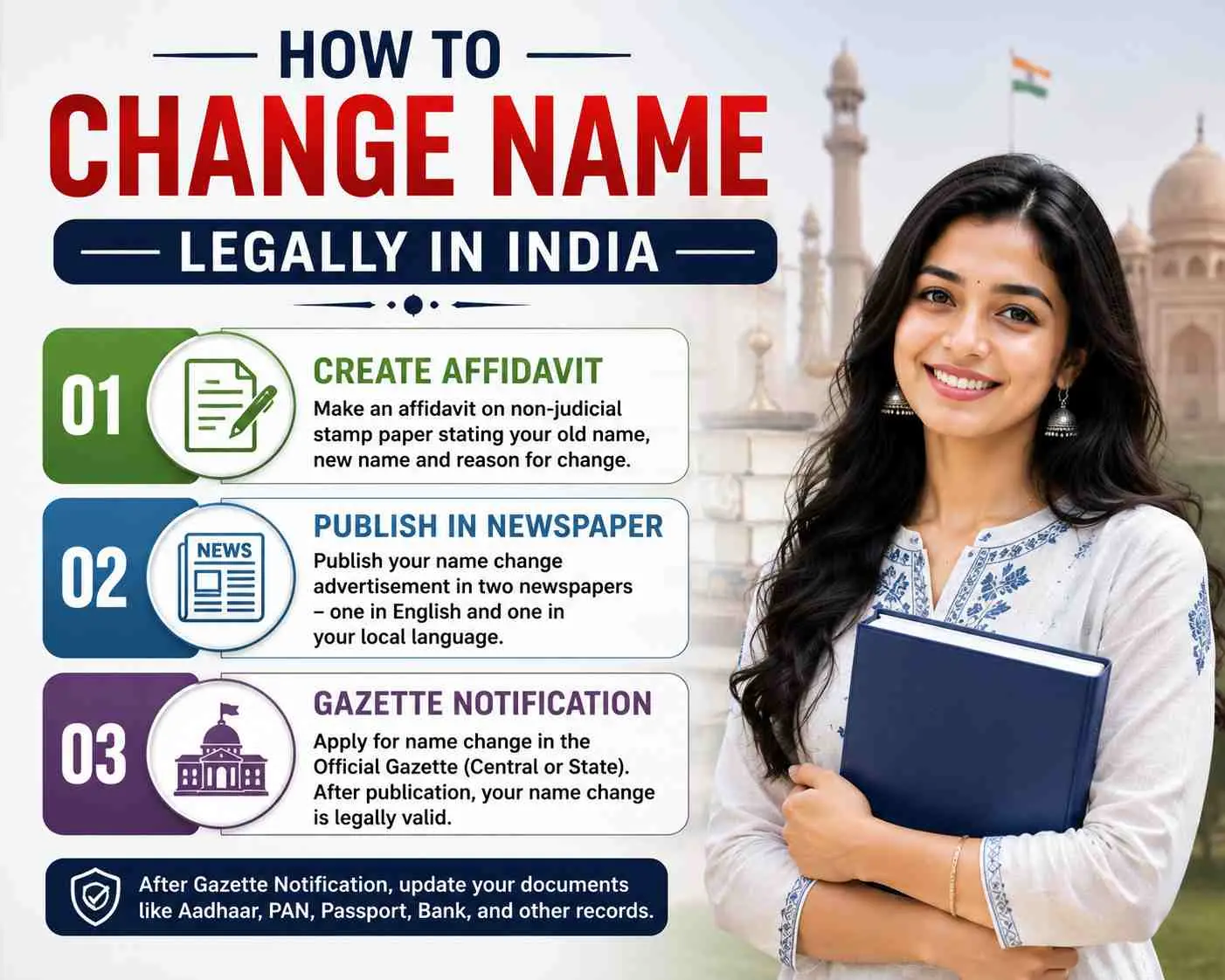
To change your name legally in India, follow three steps. Make a notarised affidavit stating your old and new name, publish the change in two newspapers (one English, one regional), then file for a gazette notification with the Department of Publication in Delhi. The Central Gazette fee is Rs 1,100 for adults and Rs 1,700 for minors, and the process takes about 30 to 45 days, all doable from home.
Definition: A gazette notification is an official notice published in the Gazette of India (Part IV) that turns your name change into a public, legally recognised record, accepted by the passport office, banks, UIDAI and government departments across the country.
For small, local needs, a notarised affidavit and a newspaper ad may pass. But for anything that matters, the gazette is the standard. The passport office, UIDAI for Aadhaar, PAN authorities, banks, universities, public sector employers and foreign embassies all treat the gazette notification as the final proof of a legal name change.
For government employees, publishing the change in the gazette is compulsory under service rules. Our honest advice: if your new name touches a passport, PAN, bank or job records, do the gazette from the start, so no office can question it later.
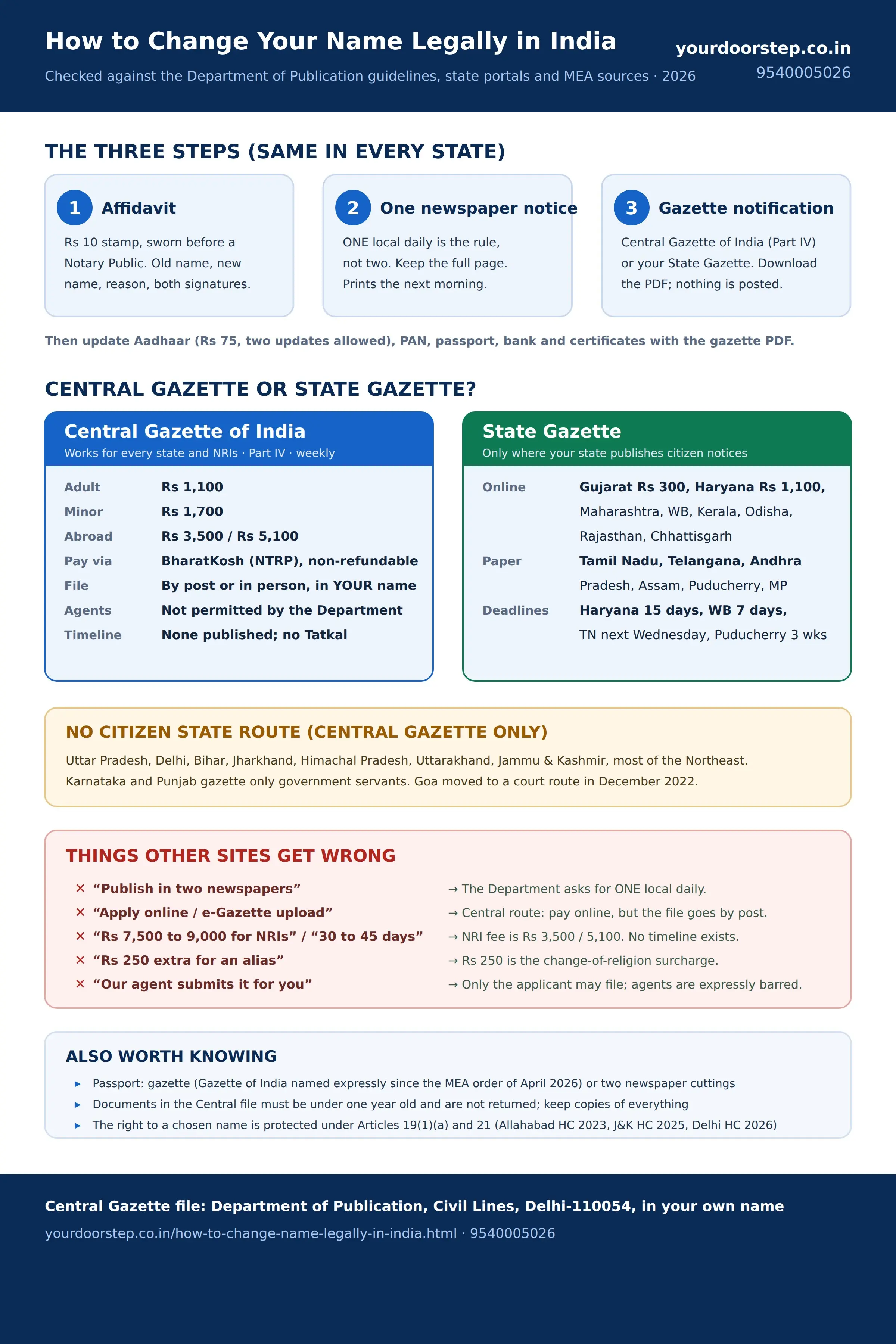
India has two kinds of gazettes. The Central Gazette, the Gazette of India, is run by the Department of Publication in Delhi and is valid across all of India and abroad. Separately, many states run their own State Gazettes for state-level records.
| Point | State Gazette | Central Gazette of India |
|---|---|---|
| Run by | Each state's printing / stationery department | Department of Publication, Government of India, Delhi |
| Who can apply | Residents of that state | Every Indian resident, no state restriction |
| Valid for | Records within that state | All of India and abroad |
| Strength | Fine for local use | The stronger, more widely accepted proof |
| Best for | A state-level record only | Passport, PAN, banks, PSU jobs, embassies |
The state picture varies a lot, and this is where most guides go silent. Here is the honest breakdown.
Maharashtra (DGPS portal), Gujarat, Odisha, Telangana, Andhra Pradesh, West Bengal (Kolkata Gazette Part-II) and Tamil Nadu run genuine state gazette services, where the state route is cheap and sometimes skips the newspaper ad.
Uttar Pradesh, Punjab, Rajasthan, Madhya Pradesh, Bihar, Jharkhand, Himachal Pradesh, and most of the Northeast have no reliable personal name-change portal, so residents use the Central Gazette.
Goa has its own law with a simpler Form A route through the Registrar, and Kerala and Karnataka publish through their state presses. Even where a state route exists, the Central Gazette remains valid.
The Central Gazette file goes to the Department of Publication, Controller of Publications, Civil Lines, Delhi-110054. The published notice is downloaded free from egazette.gov.in.
Yes. A legal name change in India runs on paperwork, not office visits. There is no name change office you must line up at in your city.
The only place the file must physically reach is the Department of Publication in Delhi, and it can go by post or courier. Our own office is in Delhi, right near the gazette office. You share your details from anywhere in India on a call or WhatsApp, we prepare the affidavit, book the newspaper ads in your state's language, pay the government fee on BharatKosh, and hand your file to the Gazette office ourselves. Once it is published, we send you the gazette PDF. Whether you are in Kochi, Guwahati, Srinagar or abroad, the process is the same.
Every legal name change through the Central Gazette follows the same three steps, in this order.
A short legal statement on stamp paper with your old name, new name, address, father's or husband's name, and the reason, signed before a notary.
Announce the change in two papers, one English and one regional. This is a public notice, so anyone can object.
The file goes to the Department of Publication, Delhi. Your notice is printed in Part IV of the Gazette of India, and you download the PDF.
An affidavit is a short legal statement on non-judicial stamp paper, usually Rs 10 to Rs 100 depending on your state. It lists your old name, new name, address, father's or husband's name, and the reason for the change. You sign it in front of a notary. This document is the foundation of the whole file, so every detail must be exact.
You announce the name change in two newspapers, one English and one in your regional language, both circulating in your area. Anyone can object if something is wrong, so the notice is a public record. The ad should carry your old name, new name, father's or husband's name, address, and the affidavit date. Keep the full original newspaper pages, not just the cut-out advert. A cutting where the date cannot be read is treated as invalid.
The complete file goes to the Department of Publication, Civil Lines, Delhi-110054. It includes the notarised affidavit, the newspaper pages, a typed proforma signed by the applicant and two witnesses, a soft copy on CD in MS Word without the witness portion, two self-attested passport photos, self-attested ID proof, a certificate declaring the hard and soft copies match, a request letter, and the BharatKosh fee receipt. Your notice is printed in Part IV of the Gazette of India, published every Saturday. You then download the PDF from egazette.gov.in. Since October 2015 the gazette is digital only, and the downloaded copy needs no further certification.
Keep these ready. Missing or mismatched papers are the top reason files get held up.
| Document | Needed? | Notes |
|---|---|---|
| Notarised name change affidavit (original) | Yes | Foundation of the file |
| Old name ID proof | Yes | Aadhaar, PAN, Voter ID or passport, self-attested |
| Address proof | Yes | Utility bill, rent agreement or similar |
| Two passport-size photos | Yes | Self-attested |
| Full copies of both newspaper ads | Yes | One English and one regional |
| Typed proforma in duplicate | Yes | Signed by applicant and two witnesses |
| Soft copy on CD (MS Word) | Yes | Without the witness portion |
| Matching certificate + request letter | Yes | Declares hard and soft copies match; with fee receipt |
| Marriage certificate | If applicable | For a surname change after marriage |
| Divorce papers | If applicable | For restoring your maiden name |
| Birth certificate | If applicable | For a minor's name change |
| Deed (MHA format) | If applicable | For government employees |
If you live abroad, your deed must be attested by the Indian Embassy or High Commission of that country.
Online you will see everything from Rs 700 to Rs 3,650, which only causes confusion. Here are the real numbers. Two costs sit inside a name change: the fixed government publication fee, and the side costs that vary by state and newspaper.
| Item | Cost |
|---|---|
| Central Gazette fee (adult) | Rs 1,100 (BharatKosh) |
| Central Gazette fee (minor) | Rs 1,700 (BharatKosh) |
| Central Gazette fee (living abroad) | Roughly Rs 7,500 to Rs 9,000, check current on BharatKosh |
| Stamp paper | Rs 10 to Rs 100 (varies by state) |
| Notary | About Rs 50 to Rs 500 |
| Newspaper ads (two papers) | About Rs 1,000 to Rs 3,500 |
| State gazette fee (where used) | Set by each state, often a few hundred rupees |
Plan for about 30 to 45 days end to end for the Central Gazette. The affidavit takes a day or two, the newspaper ads about one to two weeks including printing, and the gazette processing about three to six weeks after the file reaches Delhi. Some state gazettes are faster for state-level needs, like Maharashtra's, which often publishes in 10 to 15 days.
Errors are the real time-killer: a spelling mismatch or wrong fee category can send you back to the start. There is no official fast-track for the Central Gazette, so getting the file right the first time is the fastest route.
A gazette on its own is only useful once your other records match it. We help you update your new name across all the documents that matter.
Name change or spelling correction with the gazette as proof.
Name update through the NSDL or UTIITSL route.
Name correction on the electoral roll via Form 8.
Re-issue with your new name using the gazette and ads.
Name update at the RTO with the gazette copy.
Update your name across bank accounts and KYC records.
Records for state boards, CBSE and universities.
Correction through the local Registrar under the RBD Act, not the gazette.
Name change on policies and insurance records.
Updates on ration card and property documents.
Tell us which documents you need updated. Call 9540005026 and we guide you through each one after the gazette.
We handle name change work for people across every state and union territory of India. Big metro or remote hill district, the process runs the same way, and you never have to travel to Delhi.
Wherever you are, call 9540005026 and we handle it end to end.
Once your name change is published, use the gazette PDF to update your other records. This is the final and often the slowest part, so start early.
| Document | How to update |
|---|---|
| Aadhaar | Update at an Aadhaar Seva Kendra with the gazette as proof |
| PAN | Apply for name correction through NSDL or UTIITSL |
| Passport | Apply for re-issue with the gazette and newspaper ads |
| Driving licence | Visit the RTO with the gazette copy |
| Bank accounts | Visit your branch with the gazette, affidavit and ID |
| Voter ID | Submit Form 8 for correction |
| Board / university records | Contact your board or university with the gazette |
| Employer records | Inform HR with the gazette copy |
Keep 10 to 15 printouts of the gazette, because every office will want its own copy. We can also handle these updates for you.
After a divorce, many people want to return to their maiden name. The good news is that it uses the same three steps, and no separate court order is needed just to restore a maiden name.
To revert to your maiden name after divorce, make a notarised affidavit stating your married name and the maiden name you are returning to, publish it in one English and one regional newspaper, and file for the Central Gazette. Keep your divorce decree ready to attach with the file. Once published in Part IV, you use the gazette PDF to update your Aadhaar, PAN, passport, bank and other records back to your maiden name.
The passport is the record people worry about most, because embassies and airlines need it to match everything else. After your gazette is published, a passport re-issue with the new name is straightforward.
To change the name in your passport, apply for a re-issue on the Passport Seva portal, select the change-of-name reason, and carry the original gazette notification along with the two newspaper advertisements, your affidavit and your existing passport to the appointment. For a name change after marriage you also attach the marriage certificate, and after divorce the divorce decree. The passport office treats the Central Gazette as the accepted proof, which is exactly why the gazette route is the safe one when a passport is involved.
Add your marriage certificate to the file. The affidavit states your maiden name and married name. A name change after marriage is a choice, not a legal requirement.
The parent or guardian signs the affidavit and applies with the child's birth certificate. The Central Gazette fee is Rs 1,700, and the guardian sends the package directly.
A separate declaration is published in the gazette along with the name change, with the conversion documents attached.
A deed in the Ministry of Home Affairs format of 1987 is required, attested by the department, along with the standard steps.
The simplest case. The affidavit states the wrong spelling and the correct one, and the same three steps apply.
Not a gazette job. Corrections go through the local Registrar under the RBD Act.
The single reason files fail is a spelling gap between the affidavit, the newspaper ad and the ID proof. Pick one exact spelling, including initials and spacing, and use it on every paper. The gazette prints exactly what you submit.
State gazettes are fine for local records, but the Central Gazette is accepted by every authority, in every state, and by embassies. Doing it once, centrally, is cheaper than doing it twice.
A spelling fix on a birth certificate is not a gazette job. It goes through the local Registrar under the RBD Act. For a CBSE school name change, you may also need a court order along with the gazette.
You cannot change your name to hide your identity, escape debts or legal cases, or impersonate a famous person. Names with punctuation marks are also not accepted.
A Central Gazette notification is treated as final proof by UIDAI, the passport office, banks, universities and embassies. Once published, it is a permanent public record.
Since October 2015 the gazette is e-published only. If you lose your copy, you download it again free from egazette.gov.in.
The whole process runs on paperwork, so you can complete it from any state, or even from abroad, without visiting any office.
Plan for 30 to 45 days. It is not instant, and there is no official fast-track for the Central Gazette.
A wrong fee category, a spelling gap, or a CD that does not match the hard copy can mean a rejection and a restart. If the error is yours, the fee is not refunded.
Fee payment and download are online, but the Central Gazette file still has to reach the Delhi office. Online submission of the application itself is not yet supported.
| Mistake | Why it hurts |
|---|---|
| Different spellings across affidavit, ad and ID | Top cause of rejection |
| Signing the form with the new name instead of the old name | File gets held up |
| A CD whose contents do not match the printed proforma | File returned |
| Not keeping the full original newspaper pages | You cannot prove the publication |
| Using an affidavit more than six months old | Often not accepted |
| Leaving out the father's or husband's name in the notice | File can be questioned |
| Paying the wrong fee category on BharatKosh | Payment rejected or mismatched |
| Sending the file to a fake "state" gazette address | The office is Civil Lines, Delhi only |
Based in Delhi, right by the Central Gazette office, so your file is handed in personally and not left to the post.
Correct newspaper ads in English plus your state's language, handled for you.
Everything runs on call, WhatsApp and a short form, from any state or abroad.
We review the full file before submission, so there are fewer rejections, and we handle Aadhaar, PAN, passport and the rest after.
What is the difference between the State Gazette and the Central Gazette? State gazettes record changes for state-level use. The Central Gazette is valid across all of India and abroad, and every Indian resident can apply to it regardless of state.
How much does it cost to change your name in India? The Central Gazette fee is Rs 1,100 for adults and Rs 1,700 for minors, and the realistic total with affidavit, notary and ads is about Rs 2,500 to Rs 6,000.
Do I need one newspaper or two? Two, one English and one in your regional language, both circulating in your area.
Is a birth certificate name change done through the gazette? No. A birth certificate correction goes through the local Registrar under the RBD Act, not the gazette.
We prepare the affidavit, book the English and regional newspaper ads, pay the government fee, and file the gazette in Delhi for you, then guide you on updating Aadhaar, PAN and passport. Doorstep service anywhere in India, honest pricing.
People also search for: Gazette name change online, name change affidavit format, central gazette vs state gazette, name change after marriage, name change in passport, Aadhaar name change online, name change agent near me.
The fees, offices and process on this page are checked against official Government sources, not copied from other blogs.
Government fees and timelines can be revised from time to time. Always confirm the current figures on the official portals above before you apply.
Changing your name legally in India comes down to three clean steps: affidavit, newspaper ad, and the gazette notification. The Central Gazette is the gold standard, open to residents of every state, valid across India and abroad, with a fee of Rs 1,100 for adults. Some states offer their own gazette routes for local needs, but the central route covers everything. Plan for 30 to 45 days, match every spelling exactly, and keep plenty of copies once it is published. Wherever you are in India, or even abroad, you can get your name changed from home, and we update your Aadhaar, PAN, Voter ID and passport once it is done.
Three clean steps: affidavit, English and regional newspaper ads, and the gazette notification. The Central Gazette is valid across India and abroad, open to every state. Or let our Delhi team do the standing in line for you, wherever you are.