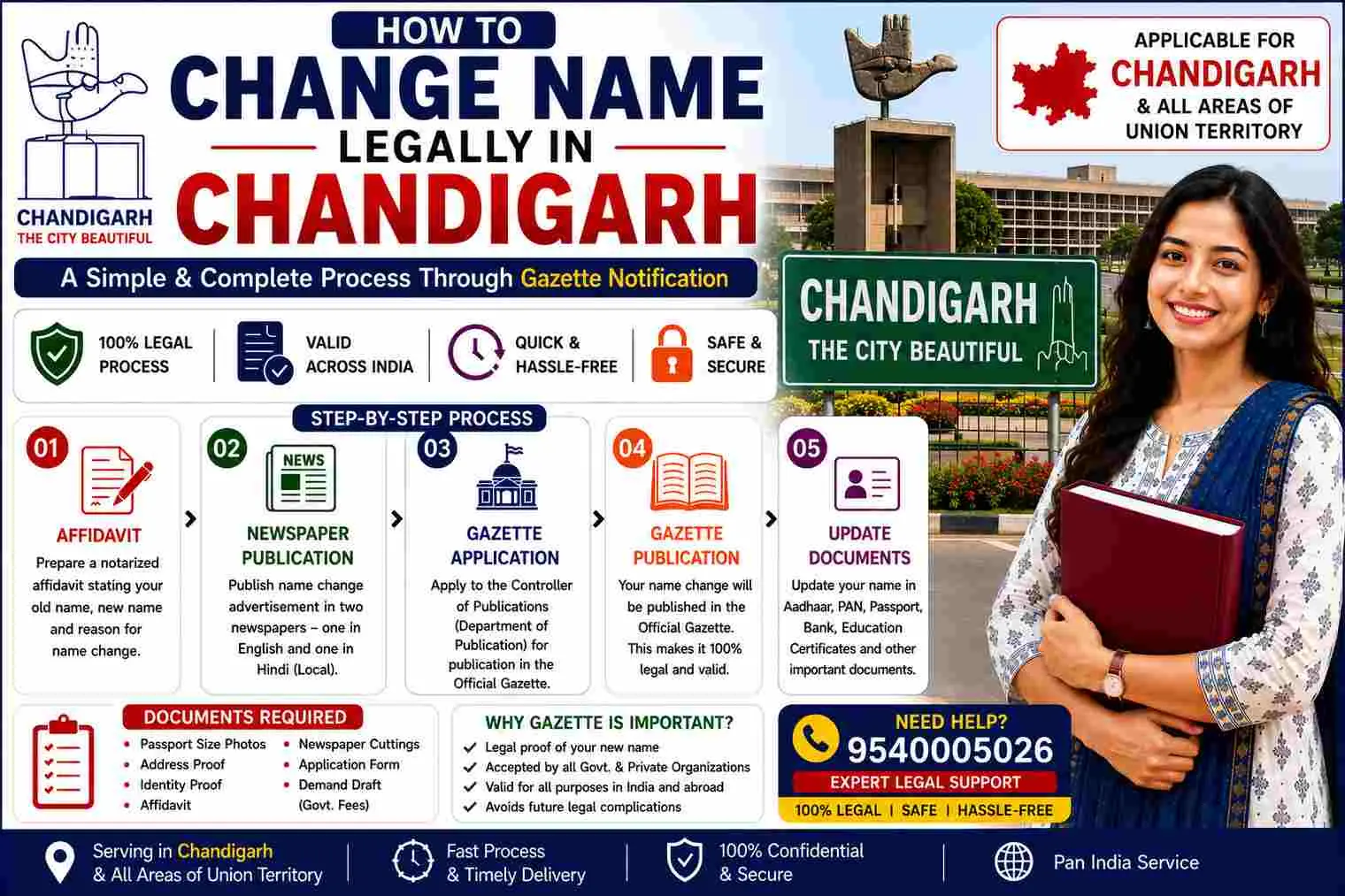
Step 1: Make and notarise the affidavit
You swear an affidavit on non-judicial stamp paper stating your old name, new name, father's or husband's name, address, and the reason for the change. It is signed before a Notary Public. In Chandigarh you can notarise it at the District Court complex in Sector 43 or through any registered notary, and buy stamp paper through authorised vendors. Fix the exact spelling of your new name now, because it is copied into everything that follows.
Step 2: Publish the change in a newspaper, one, not two
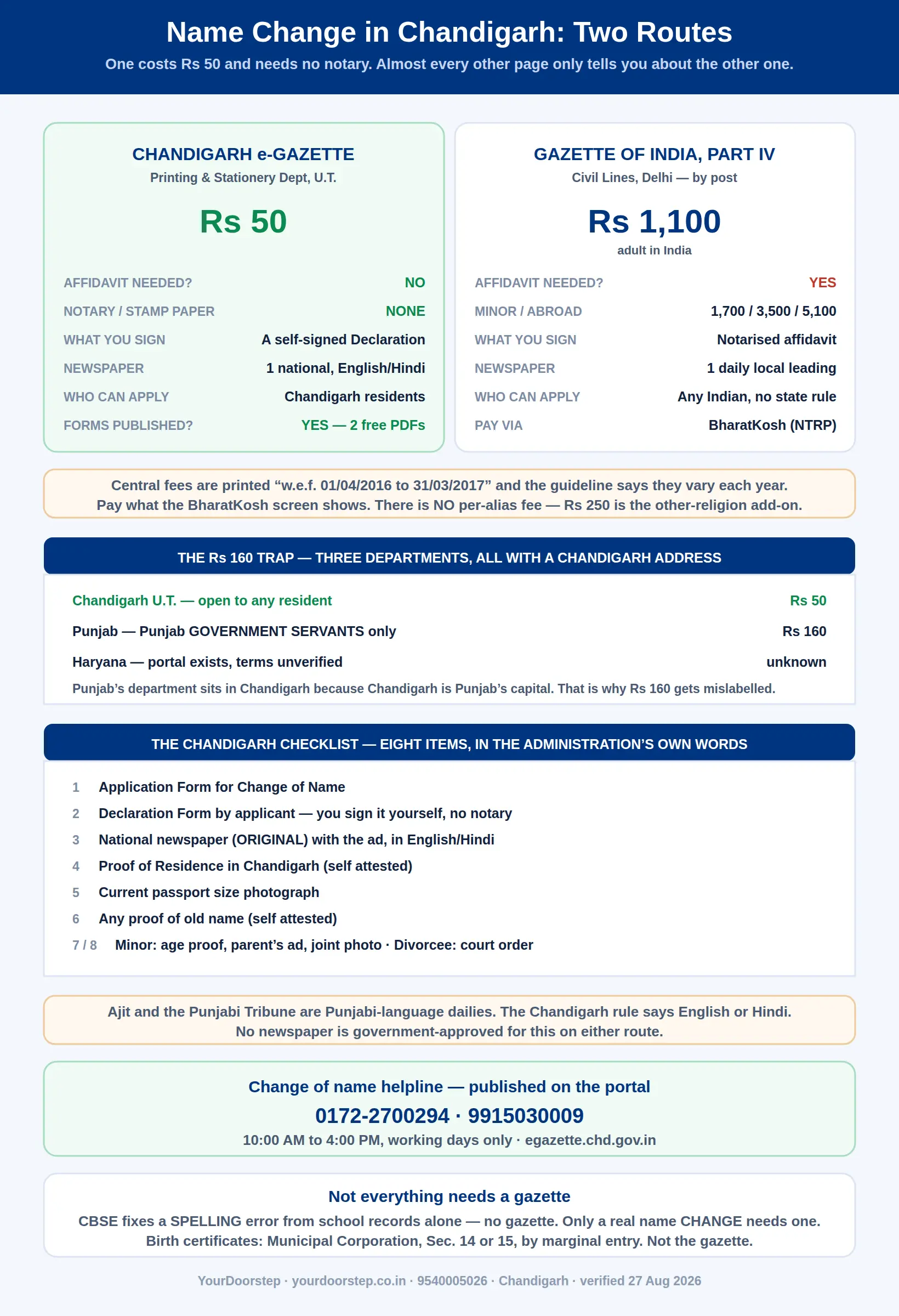
Both routes require one advertisement, worded slightly differently. The Department of Publication says the change "should be advertised in one of the daily local leading newspapers stating therein Father's/Husband's name along with residential address". Chandigarh's own instruction asks for a "National newspaper (Original) containing the advertisement for change of name of applicant in English/Hindi". The notice itself carries your old name, new name, father's or husband's name and address.
Step 3: File for the gazette notification
What you submit depends on the route. For Chandigarh: the application form, your self-signed Declaration, the original national newspaper, Chandigarh residence proof, a passport photo, proof of your old name and Rs 50, no affidavit. For the Central route: an undertaking, the original newspaper, the proforma in duplicate, a CD in MS Word, two photos, ID proof, a similarity certificate and the BharatKosh receipt. Historically this page described only the second. You submit the affidavit, the newspaper, ID and address proof, a passport-size photo, a signed declaration and a soft copy, along with the government fee. For the local route the file goes to the Department of Printing and Stationery, Chandigarh Administration. For the Central route it goes to the Department of Publication, Civil Lines, Delhi-110054, and your notice is printed in Part IV of the Gazette of India. Once published, the gazette notification is your permanent legal proof.