

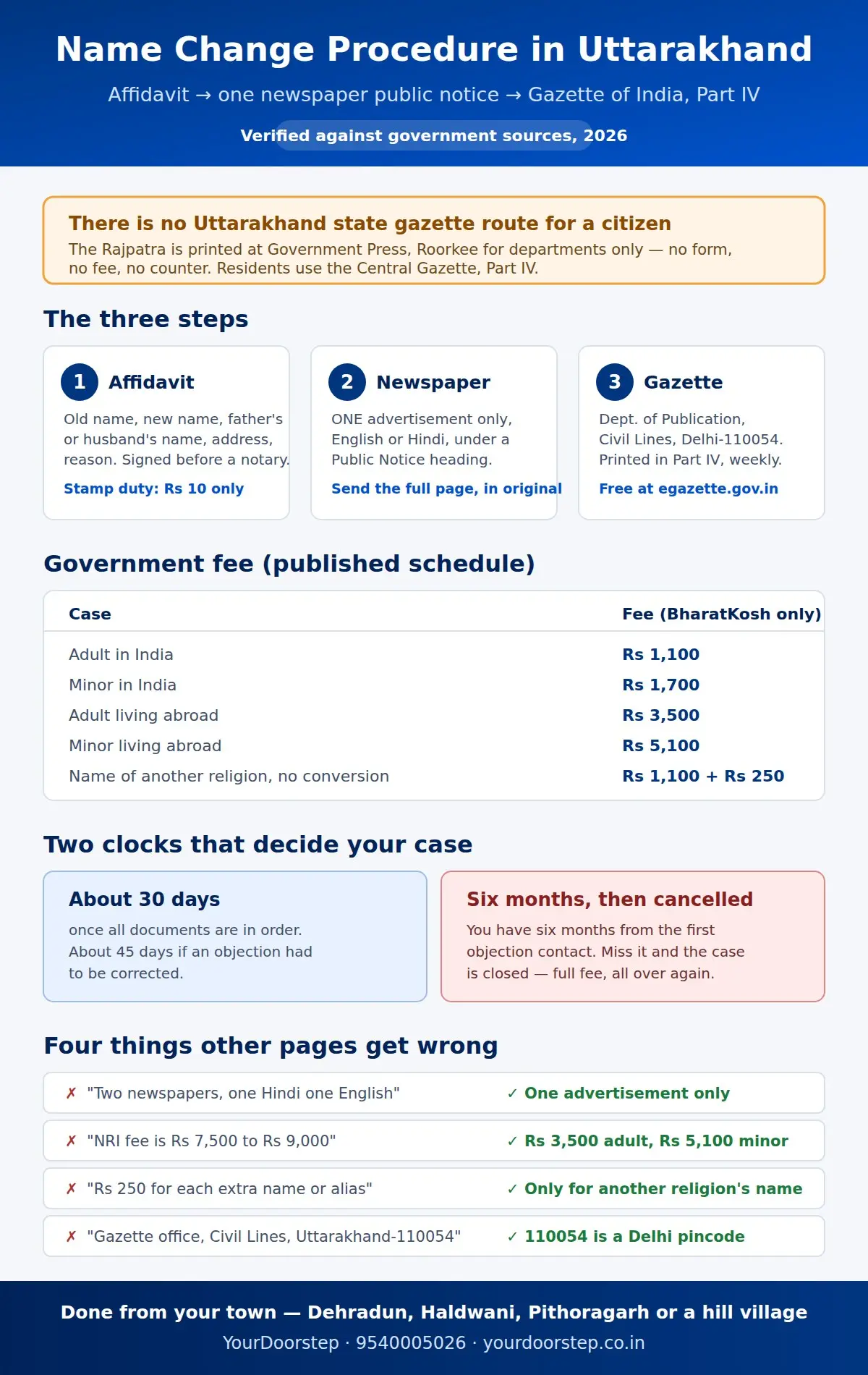
Step 1: Make the name change affidavit
An affidavit is a short sworn statement on non-judicial stamp paper. It lists your old name, new name, address, father's or husband's name, and the reason for the change. You sign it in front of a notary.
The stamp duty in Uttarakhand is Rs 10. That is not a guess. The Stamp & Registration Department of Uttarakhand publishes a duty chart, and row 24, Registration of Affidavit (Article 4), reads "Stamp Duty Payable Rs 10 Only". The Rs 100 shown in the same row is the registration fee, which applies only if you actually register the affidavit; a name-change affidavit normally is not registered. So if someone quotes you Rs 100 or Rs 500 "for the stamp paper", they are quoting their own margin. Vendors commonly sell Rs 20, Rs 50 and Rs 100 sheets and over-stamping is legally harmless, it is just not required.
Uttarakhand runs e-stamping under the Uttarakhand Stamp Rules 2012 and the 2015 amendment, and the Department of Stamps and Registration publishes an official List of Authorised e-Stamp Vendors with over 1,200 entries covering Dehradun, Haridwar, Roorkee, Rishikesh, Nainital, Haldwani, Kashipur, Almora, Rudraprayag, Chamoli, Bageshwar and Pithoragarh. Any listed Authorised Collection Centre can issue you an e-stamp.
On the notary: notaries in India are appointed by the Central Government and by State Governments, and they sit at the district court and tehsil complexes. There is no citizen-facing "find a notary near me" directory, the Government of India's notary portal states that its online services are for Central Notaries only. Ask to see the notary's Certificate of Practice and registration number rather than trusting a signboard.
One thing worth knowing before you spend on this: the Department of Publication's own guidelines never mention an affidavit, stamp paper or a notary at all. What the gazette file actually needs is the Department's own Undertaking proforma. The notarised affidavit is what banks, UIDAI, RTOs, schools and employers ask for, which is why almost everyone makes one anyway, but it is a customary evidentiary document, not a statutory form under any Act. There is no prescribed statutory format for it.
Step 2: Publish the change in a newspaper
One advertisement, in one daily newspaper, English or Hindi. It must appear under a Public Notice heading and carry your old name, new name, father's or husband's name, and full residential address. You send the newspaper in original, the whole page, masthead and date visible. The "two papers, one Hindi and one English" rule you will read elsewhere is not in any Department guideline; see the newspaper section for the exact wording and for when a second advertisement is still worth taking.
Step 3: Get the gazette notification
Now the file goes to The Controller of Publication, Department of Publication, Civil Lines, Delhi-110054, behind the Delhi Vidhan Sabha, near Vidhan Sabha Metro Station. It includes the undertaking, the original newspaper, the typed proforma in duplicate with two witnesses, a CD carrying the print matter in MS Word, a certificate that the hard copy and soft copy match, two self-attested passport photos, self-attested photo ID, and a request letter with the fee receipt.
Public dealing hours at the Department are 10:00 am to 1:00 pm and 2:00 pm to 4:00 pm on working days, closed on Saturdays, Sundays and gazetted holidays. Your notice is printed in Part IV of the Gazette of India, published weekly, and you then download the PDF yourself from egazette.gov.in, the guidelines say so in as many words: "The applicant is requested to download his/her gazette from the website www.egazette.gov.in." No physical gazette copy is posted to you. The PDF is your legal proof and needs no stamp or attestation.