

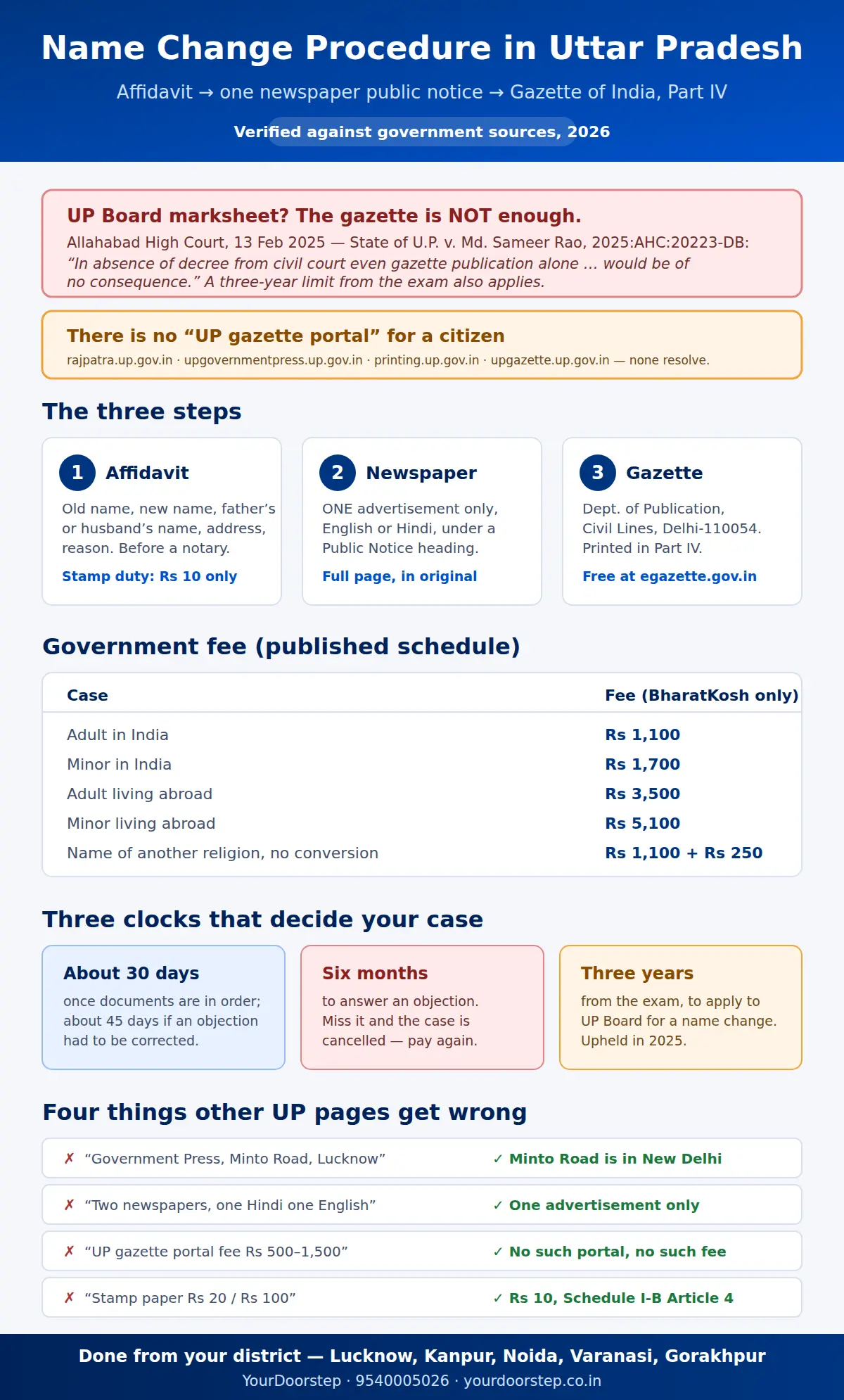
Step 1: Make the name change affidavit
An affidavit is a short sworn statement on non-judicial stamp paper. It lists your old name, new name, address, father's or husband's name, and the reason for the change. You sign it in front of a notary.
The stamp duty in Uttar Pradesh is Rs 10. Schedule I-B of the Indian Stamp Act as applicable in UP is published on the state's own Stamp & Registration portal, and Article 4, "Affidavit, including an affirmation or declaration", reads ten rupees. Article 42, the notarial act itself, is another ten rupees. Everything above that is over-stamping: legally harmless, and not required. So when a page tells you the stamp paper "costs Rs 20, or Rs 100, or Rs 10 to Rs 100 depending on the state", it is describing what a vendor happened to sell, not what the law asks for.
E-stamps are available across UP. The Stamp & Registration Department's portal at igrsup.gov.in links directly to SHCIL for e-stamp verification and self-printing, and publishes a district-and-tehsil-wise list of Authorised Collection Centres, a live PDF, updated in June 2025, covering Agra, Aligarh, Ambedkar Nagar, Amethi, Amroha, Auraiya, Ayodhya, Azamgarh, Baghpat, Bahraich, Ballia, Banda, Barabanki and on through the state. Any listed ACC can issue you an e-stamp.
For the notary, there is no useful online directory, and we would rather say so than send you to a dead link. The Government of India's notary portal states that its online services are for Central Notaries only, and the india.gov.in lookup requires the notary's registration number before it will show you anything. Notaries in UP are appointed by both the Central and the State Government, and in practice you find one at the district court, tehsil or collectorate. Ask to see the Certificate of Practice and registration number.
One thing worth knowing before you spend: the document the gazette file actually turns on is the Department's own proforma, which is headed "Undertaking / Affidavit" and is signed by you in your old name before two witnesses. A separate Magistrate-attested affidavit is required in one specific case, where you adopt a surname different from your father's or mother's, or add a surname you never had. What the guidelines do not prescribe is the notarised affidavit on Rs 10 stamp paper that banks, UIDAI, RTOs, schools and employers ask for. Make one anyway, because they will ask, but know it is a customary evidentiary document with no statutory format, not something the Department demands.
Step 2: Publish the change in a newspaper
One advertisement, one newspaper, English or Hindi. It must appear under a Public Notice heading, the guidelines say so explicitly and add that it "should not be advertised in Change of Name heading", and it must carry your old name, new name, father's name and full residential address. You send the newspaper in original. See the newspaper section for which papers work in UP and when a second advertisement is still worth taking.
Step 3: Get the gazette notification
The file goes to The Controller of Publication, Department of Publication, Civil Lines, Delhi-110054, behind the old Delhi Vidhan Sabha, near Vidhan Sabha Metro Station. It includes the undertaking, the original newspaper, the prescribed proforma in two typed copies signed in your old name with the full details of two witnesses, a CD with the print matter, a certificate signed by you that hard copy and soft copy match, two self-attested passport photos, self-attested photo ID for you and for each witness, and a request letter with the fee receipt.
Public dealing hours are 10:00 am to 1:00 pm and 2:00 pm to 4:00 pm on working days, closed Saturdays, Sundays and gazetted holidays. Your notice is printed in Part IV of the Gazette of India and you download the PDF yourself from egazette.gov.in, the guidelines say it in as many words: "The applicant is requested to download his/her gazette from the website www.egazette.gov.in." No physical copy is posted to you. The PDF is your legal proof and needs no stamp or attestation.