A trusted agent who settles the two decisions Nagaland files turn on: the one plain-letter rendering of a name the databases cannot spell, and the one surname spelling that must hold across the Indigenous Inhabitant Certificate, the board record and Aadhaar. Both ads run in English, because only Nagaland can say that. All 17 districts served, and the Delhi Naga community can walk into Burari.
The Central Gazette route, the umlaut rendering question, the tribe-surname and Indigenous Inhabitant Certificate chain, and how NBSE corrections are coordinated, explained on video.
Changing your name in Nagaland means an affidavit, two newspaper ads, and a gazette notification, and it means solving two puzzles the rest of India rarely meets: a surname that must read identically across the Indigenous Inhabitant Certificate, the board record and Aadhaar, and, for many, a name whose correct spelling carries a mark, the umlaut in Sümi or Chümoukedima, that no government database can store. A good name change agent in Nagaland settles both deliberately, and knows the practical mercies of this state too: the ads run in English, because English is the official language here and nowhere else in India can say that alone. This page explains what an honest agent does, the real fees, and how we serve all seventeen districts and every Naga student in Delhi.
A name change agent in Nagaland handles your legal name change end to end: affidavit, two English newspaper ads (Nagaland's official language is English, so the regional-language question answers itself), and the Central Gazette filing (Rs 1,100 adult, Rs 1,700 minor on BharatKosh, valid across India). There is no gazette office in Kohima for personal changes; the office is in Delhi and payment is online. YourDoorstep serves all 17 districts remotely.
A name change agent in Nagaland is a private documentation service that settles the diacritic rendering and the tribe-surname spelling, prepares the affidavit and two English ads, files the Central Gazette notification, and coordinates the Indigenous Inhabitant Certificate chain and NBSE records, with one exact form throughout.
Yes, completely. The application always remains yours: the affidavit carries your name and signature, the ads announce your change, the fee receipt is generated in your name, and the gazette publishes your details. The agent prepares, files and follows up on your behalf; the Department of Publication in Delhi processes represented filings every working day.
What no agent can do is sign for you, invent documents, or promise approval. Anyone offering that is the agent to avoid.
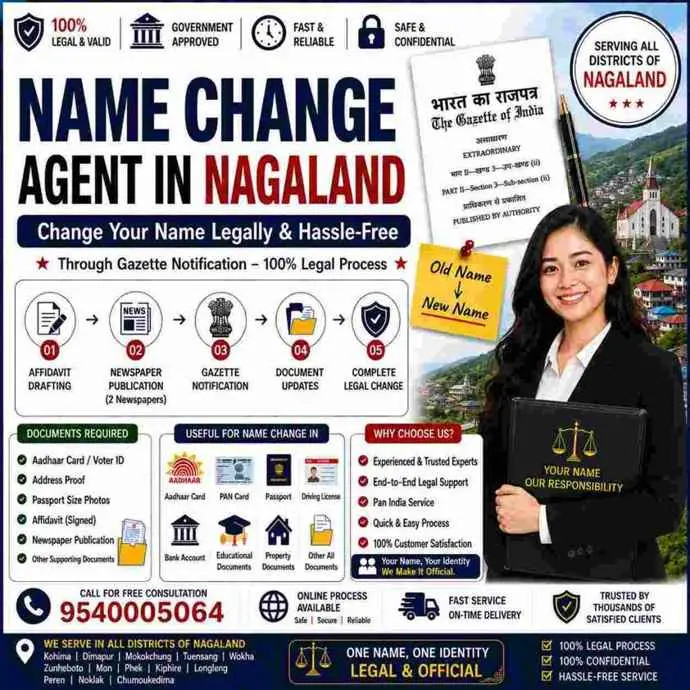
The Nagaland Gazette, published from Kohima, does real work: state notifications, appointments, rules. What it does not carry is your personal name change, and Nagaland runs no personal name-change portal. For a personal change, every Nagaland resident uses the Central Gazette: the Gazette of India, published by the Department of Publication, Civil Lines, Delhi 110054, at Rs 1,100 for adults and Rs 1,700 for minors on BharatKosh, with about Rs 250 per additional correction in the same file. It is valid in every state and abroad, and it is what the passport office, UIDAI, banks, NBSE and embassies accept without question.
One payment correction stated in advance, because this niche's older pages repeat it for state after state: no demand draft to any state-level Controller of Publications belongs in your central file. Payment is online on BharatKosh, the receipt is in your name, and the receiving office is in Delhi. An agent who dictates a demand draft to a state Controller has copied their process from the same error family you were trying to escape.
Everywhere else in India, the two-ad requirement means one English daily and one regional-language daily, with transliteration proofing between the two. Nagaland is the one state where the question answers itself: English is the sole official language here, so both ads sensibly run in English, one widely-circulated daily alongside one strong Nagaland daily, Nagaland Post, Eastern Mirror or The Morung Express, each with real circulation in the state.
No transliteration gap, no script proofing, one spelling in both papers, matched letter for letter to the affidavit. It is a small structural gift, and we use it to make Nagaland files among the cleanest we run.
Open the official map: Chümoukedima, Dzükou, Sümi, Küzholuzo. The diacritic is correct, official and meaningful. Now open Aadhaar, PAN or a passport form: the databases store plain letters, and every clerk improvises differently, Sumi here, Suemi there, Chumoukedima on one record and Chuemoukedima on another. One person, one name, several renderings, and a verification that reads them literally.
The fix is not to fight the databases; it is to choose. One plain-letter rendering of your name, decided deliberately by you, recorded through the gazette letter for letter, and then applied identically across Aadhaar, PAN, passport, the board record and everything else. Whether the umlaut becomes u or ue is your call to make once, in writing, and our job is enforcing that single form through the affidavit, both ads, the file and the gazette, so no clerk ever improvises on your behalf again. No other page in this state's results has ever mentioned the problem, and it sits under half the mismatches we see from here.
Naga surnames carry the tribe and clan: Jamir, Longkumer, Imchen, Pongen, Ozukum among the Ao; Kire, Sekhose, Meru among the Angami; Zhimomi, Achumi, Swu among the Sümi; Ngullie, Odyuo, Ezung, Kikon among the Lotha; and their counterparts across the Chakhesang, Konyak, Rengma, Zeliang, Phom, Chang, Yimkhiung, Sangtam, Khiamniungan and Pochury communities. They are real surnames, proudly carried, and they drift in spelling across the record chain that matters most here: the Indigenous Inhabitant Certificate, the NBSE certificate, Aadhaar, the bank.
When a job or admission verification reads that chain, every link must say the same thing. Our work is the audit and the anchor: every document you hold read side by side, the one spelling chosen in writing, the gazette publishing it as the legal standard, and then each record, board, Aadhaar, bank, aligned to it in sequence, with the certificate chain's own procedures respected. The gazette cannot rewrite the Indigenous Inhabitant Certificate by itself, but it gives every office in the chain the one legal basis they all accept, which is exactly what a mismatched chain lacks.
Board records anchor the student cases: an NBSE certificate from Kohima carrying one spelling, Aadhaar another, discovered when an admission or recruitment form bounces. The order is fixed: the gazette records the one legal form first, and the board's own correction process then updates the certificate with the gazette as supporting proof, one spelling throughout. Run backwards, both halves get done twice.
The board itself expects this order: NBSE accepts a change of name supported by an affidavit and the Government gazette notification, which is exactly the sequence we build. We audit, lock the form, publish, then assemble the board file.
From Mon, Noklak, Kiphire, Shamator or Tuensang, the journey to any facility is the longest in the state. The process never requires it: documents move as photographs on WhatsApp, attestation is mapped as near to you as practical, the ads run in dailies circulating statewide, and the file reaches Delhi by our hands.
And at the other end of the map, Delhi holds one of the largest Naga student and professional communities in India. If that is you, our Burari office sits minutes from the Civil Lines gazette office, and walking in with your documents puts your file into the same-day hand-delivery lane.
Nobody can make the Government print faster, and no tatkal exists at any price; the gazette publishes weekly in order received. What genuinely changes your timeline is submission mode: files handed in at the Civil Lines counter process in roughly four to five weeks, while couriered files commonly take eight to twelve. From Nagaland, every local option is the courier lane. Ours is not: every file we handle is hand-delivered into the faster lane, with objections answered at the counter, usually within a day.
The same clean sequence, with the chain audited and the form locked first.
We read the Indigenous Inhabitant Certificate, board record and Aadhaar side by side; you choose one plain-letter rendering and one surname spelling, locked in writing.
We draft the notarised affidavit, then book two English dailies, proofed against each other and the affidavit letter for letter.
Rs 1,100 on BharatKosh, the file hand-delivered at the Department of Publication, Civil Lines, Delhi, and the published gazette PDF sent to you.
An honest quote has two visible parts.
The Government money (fixed, paid in your name):
The agent service charge sits on top, covering the rendering and surname decisions, drafting, attestation mapping, ad booking and proofing, file assembly, submission, follow-up, objection handling, and board or chain coordination where needed. A realistic honest total for most cases lands between Rs 2,500 and Rs 6,000, with no urgency premium, because none exists. "Rs 999 complete" fails arithmetic: the Government fee alone is Rs 1,100.
| Cost part | Amount | Paid to |
|---|---|---|
| Central Gazette (adult) | Rs 1,100 | Government, via BharatKosh, in your name |
| Central Gazette (minor) | Rs 1,700 | Government, via BharatKosh, in your name |
| Additional correction (same file) | Rs 250 each | Government, via BharatKosh |
| Two English newspaper ads | Rs 800 to Rs 3,000 | Newspapers |
| "State Controller" DD | Rs 0 (not your central file) | Nobody; pay on BharatKosh |
| "Tatkal / urgent" fee | Rs 0 (does not exist) | Nobody; refuse it |
Test any agent, including us.
Your details move on WhatsApp, attestation is mapped around your access, and the file lands in Delhi without you travelling. Naga students and professionals in Delhi are welcome to walk into our Burari office, minutes from the Civil Lines gazette office.
Read the Nagaland procedure, the NE naming siblings, or the pages our clients open most.
Aadhaar name change, rendering unification and spelling correction, PAN card update, Voter ID (EPIC) correction, passport re-issue with the corrected name, driving licence update at the RTO, and bank KYC name change.
Record-chain alignment where the Indigenous Inhabitant Certificate, board record and Aadhaar disagree, with each office's own procedure respected and the gazette as the shared legal basis.
Nagaland Board of School Education certificate corrections coordinated gazette-first, plus CBSE and university records, and recruitment-verification alignment to deadline.
The diacritic rendering decision, name change after marriage on your terms, minor name changes, birth certificate correction through the local Registrar, and LIC, ration card and land-record updates.
One agent, one accountable team, from the rendering decision to the last aligned record.
Indigenous Inhabitant Certificate, board record, Aadhaar, bank: we lay them side by side first, because fixing one record against the wrong reference just relocates the mismatch.
Whether the umlaut becomes u or ue is a choice, and either is fine; what fails is letting each clerk choose differently. One written decision, enforced everywhere.
Two English ads mean zero transliteration risk, a gift no other state gets. We match both ads to the affidavit letter for letter and bank the advantage.
Reverting means repeating the entire process. The rendering and surname conversations happen before the affidavit is typed.
Message or call us with your name as each document shows it, diacritics and all, your chosen final rendering, and your district. You get the chain-audit plan, the document list and a transparent quote, Government fee shown separately, in minutes, and if you are in Delhi, the Burari door is open.
People also search for: name change agent in Kohima, name change agent in Dimapur, name spelling with umlaut on Aadhaar, indigenous inhabitant certificate name mismatch, NBSE certificate name correction, name change consultant in Nagaland.
A name change agent in Nagaland earns their fee at two decisions no form will make for you: the one plain-letter rendering of a name the databases cannot spell, and the one surname spelling that must hold across the Indigenous Inhabitant Certificate, the board record and Aadhaar. Around them sit the state's structural gifts and the niche's standard corrections: both ads run in English, because only Nagaland can say that; the gazette office is in Delhi, payment is BharatKosh, and no tatkal can be bought. We audit the chain side by side, enforce one form letter for letter, hand-deliver every file at Civil Lines into the 4-to-5-week lane, and keep the Burari door open for Delhi's Naga community. The Government fee is Rs 1,100 and always shown separately; the honest total sits between Rs 2,500 and Rs 6,000. Judge any agent by the checklist above, then send us one message from any of the seventeen districts, or any campus.
Share your name as each document shows it, diacritics and all, your chosen final rendering and district. You get the chain-audit plan and a transparent quote in minutes, with the Government fee shown separately, and if you are in Delhi, the Burari door is open.